We Used to Navigate by Memory and Paper. Then We Handed Our Brains to a Satellite.
We Used to Navigate by Memory and Paper. Then We Handed Our Brains to a Satellite.
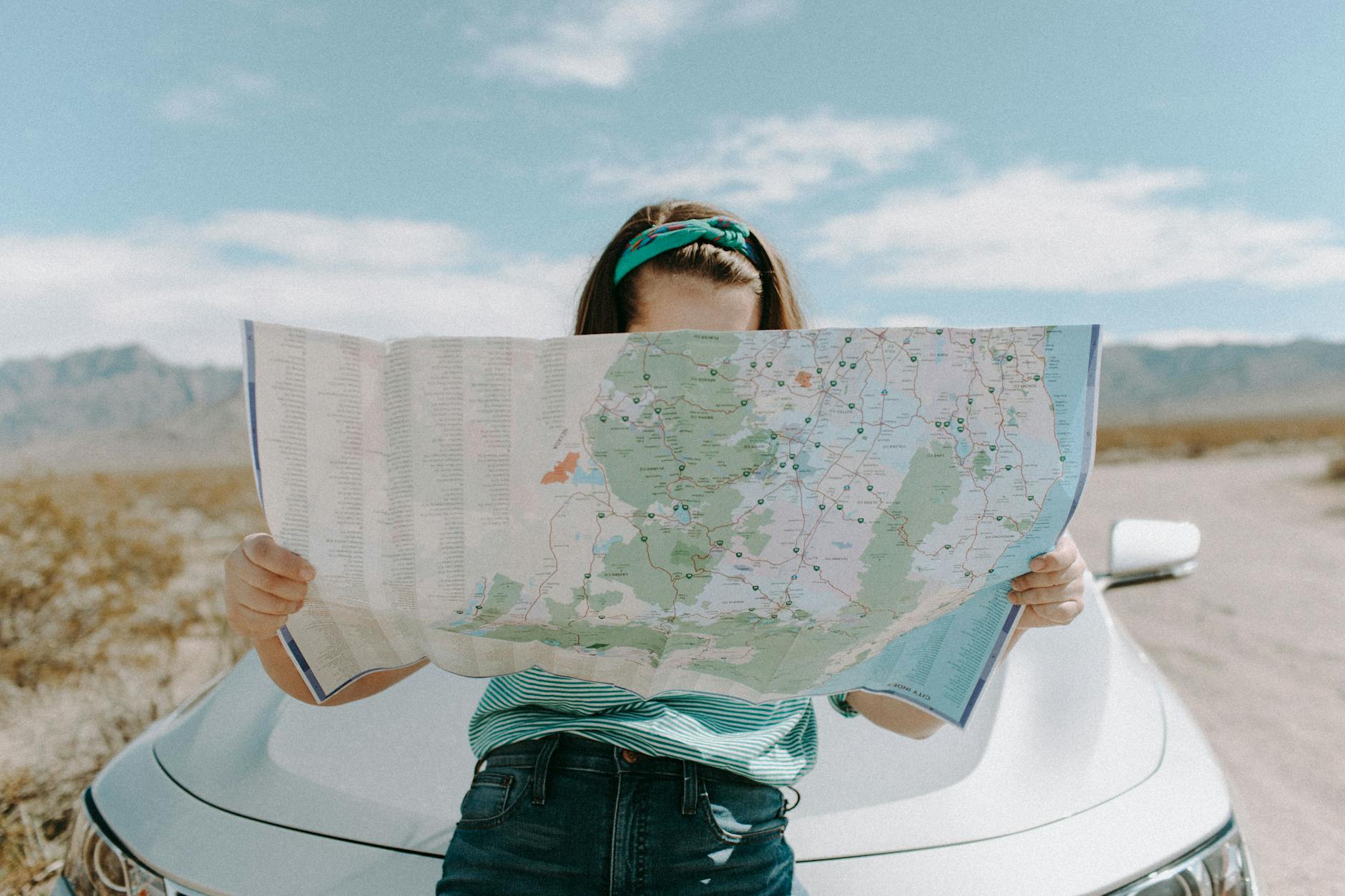
Picture this: you're driving through an unfamiliar city in 1987. You've got a folded paper map across your lap, a list of handwritten turn-by-turn notes on a legal pad wedged against the dashboard, and a vague but growing suspicion that you missed the exit about four miles back. There's no voice telling you to reroute. There's no little blue dot showing you exactly where you are. There's just you, the road, and the slowly dawning awareness that you are genuinely, completely lost.
For most of American history, that was just called driving.
The Paper Map Was a Whole Ecosystem
Before GPS became a consumer product in the early 2000s, navigation was a skill — one that people practiced, debated, and occasionally argued about loudly in the front seat of a station wagon.
The Rand McNally Road Atlas was a fixture in American households for decades. First published in 1924, it became the unofficial bible of road travel — a thick, spiral-bound book of state-by-state maps that families consulted before long trips and kept wedged under the passenger seat for emergencies. Gas stations sold individual state maps for a quarter, sometimes for free, because the oil companies understood that a driver who knew where they were going was a driver who kept driving — and kept stopping to fill up.
Planning a road trip meant spreading a map across the kitchen table the night before, tracing a route with a highlighter or a finger, and writing down the key turns in order. Travelers memorized highway numbers. They knew which interstates ran north-south and which ran east-west. They understood that even-numbered highways generally went horizontally and odd-numbered ones ran vertically — a federal numbering system that was once common knowledge and is now almost entirely forgotten.
Asking for Directions Was a Life Skill
When the map failed — and it often did — you stopped and asked someone. A gas station attendant. A person walking their dog. A cashier at a diner who'd lived in the town her whole life and could tell you exactly where the road forked and which way to go.
This sounds quaint now. But it required a specific kind of social confidence, the ability to describe where you'd come from, articulate where you were trying to go, and translate the answer you received — usually given in landmarks rather than street names — into actual navigation. "Turn left at the old Sears, go past the water tower, and you'll see the sign." That was a perfectly normal set of directions in 1975.
Schools treated map reading as a genuine academic subject. Geography classes taught kids how to interpret scale, read contour lines, and orient themselves using cardinal directions. Military service reinforced these skills for millions of Americans during World War II and beyond. The ability to understand your physical position in the world was considered a mark of basic competence, like knowing how to change a tire or balance a checkbook.
The GPS Revolution Changed More Than Navigation
The first consumer GPS devices appeared in the late 1990s, but it was the mid-2000s — with the arrival of affordable dashboard units from Garmin and TomTom — that navigation genuinely shifted. Then smartphones arrived and finished the job. By the time Google Maps introduced turn-by-turn voice navigation in 2009, the paper map was effectively obsolete for most Americans.
The convenience is extraordinary and genuinely worth celebrating. GPS has reduced traffic accidents caused by distracted map-reading. It has made it possible to find an address in an unfamiliar city without any advance preparation. It has democratized travel in ways that are easy to take for granted.
But researchers have been quietly documenting a cost.
Studies from University College London and other institutions have found that heavy reliance on GPS navigation is associated with reduced activity in the hippocampus — the part of the brain responsible for spatial memory and navigation. When we stop building mental maps of our environments, that cognitive muscle weakens. People who navigate by GPS consistently show less ability to recall routes, estimate distances, or describe how streets connect to each other than people who navigate without it.
In other words, we didn't just outsource the task. We gradually gave away the skill.
What We Knew That We've Forgotten
There's a particular kind of spatial confidence that older Americans describe — the feeling of knowing a city's bones, of understanding how the neighborhoods connect, of being able to picture the route before you've driven it. Cab drivers in major cities famously developed extraordinary mental maps through years of unassisted navigation. London's black cab drivers, who had to pass a notoriously difficult test called "The Knowledge," showed measurably enlarged hippocampal regions compared to non-drivers.
Most of us aren't training for The Knowledge. But we used to build smaller versions of that mental geography just by moving through the world without a device telling us where to look.
Lost, But Never Really Found
None of this is an argument for throwing your phone out the window. GPS is one of the most useful technologies ever placed in ordinary hands, and there's no serious case for going back to arguing over a folded map in a Denny's parking lot.
But it's worth pausing on what it meant to navigate by instinct, memory, and paper — to know a place well enough to move through it without help. That wasn't just a workaround for the absence of better technology. For millions of Americans, it was a genuine relationship with the physical world around them.
We traded that for frictionless convenience. Most days, that feels like a pretty good deal. Occasionally, though, when the signal drops and you realize you have absolutely no idea which direction is north, you catch a small glimpse of what used to be a very ordinary skill.