The Morning Migration That Built America
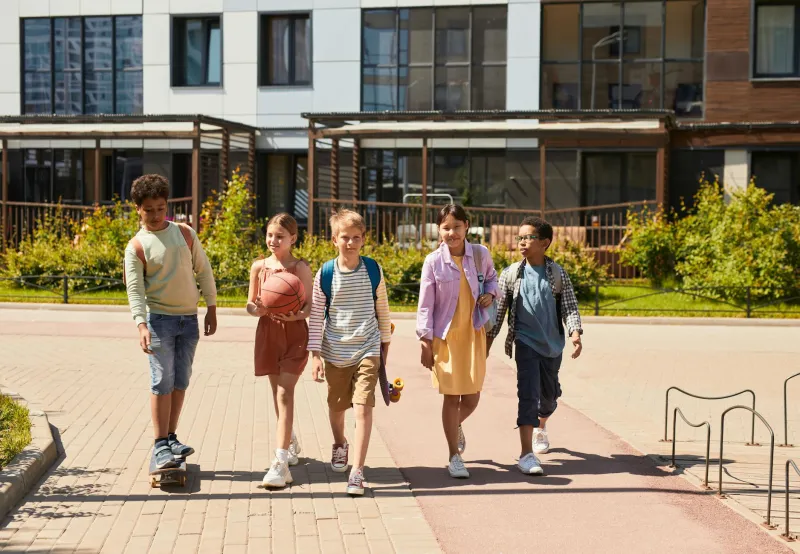
Every weekday morning in 1975, American neighborhoods came alive with a sight that's now almost extinct: streams of children walking to school. They traveled in loose packs, crossing streets without crossing guards, navigating shortcuts through vacant lots, and arriving at school having already logged a mile or more of daily exercise before first period even began.
This wasn't considered remarkable parenting or progressive education policy. It was simply how children got to school. In 1970, nearly 90% of kids who lived within a mile of school walked or biked there. The morning walk was as routine as brushing teeth, and just as unremarkable.
These weren't supervised nature walks or organized fitness activities. Children as young as six navigated busy intersections, figured out the fastest routes, and developed an intimate knowledge of their neighborhoods that GPS apps couldn't match. They learned to read traffic patterns, weather signs, and the subtle social dynamics of the street.
The Unplanned Fitness Program
Without anyone calling it exercise, American children were getting substantial physical activity built into their daily routine. The average walk to school was about three-quarters of a mile each way — meaning kids were logging at least 1.5 miles of walking daily, plus whatever additional movement happened during recess and after-school play.
This wasn't just movement; it was functional fitness that built real-world skills. Children developed spatial awareness, learned to judge distances and timing, and built the kind of practical intelligence that comes from navigating the physical world independently.
The health benefits were profound, though no one was tracking them at the time. Childhood obesity rates in 1970 hovered around 5% — compared to today's rate of nearly 20%. Kids were leaner, had better cardiovascular fitness, and showed higher levels of what we now call "executive function" — the mental skills that include focus, self-control, and cognitive flexibility.
When Independence Started at Age Six
Perhaps most remarkably, this daily journey fostered a kind of independence that seems almost unimaginable today. Six-year-olds were expected to get themselves to school on time, in all weather conditions, without adult supervision. They learned to solve problems on the fly: what to do if it started raining, how to handle a broken shoelace, whether to take the long way around construction.
This independence extended far beyond the school commute. Children who walked to school were also more likely to play outside unsupervised, explore their neighborhoods, and develop what researchers now call "environmental competence" — the confidence and skill to navigate the physical world.
Parents didn't see this as neglect or risk-taking. It was considered essential preparation for adulthood. Children needed to learn self-reliance, and the daily walk to school was one of the first and most important ways they developed it.
The Fear That Changed Everything
The transformation began in the 1980s, driven by a complex mix of suburban design, safety fears, and changing family structures. High-profile cases of child abduction, though statistically rare, created a climate of fear that made the unsupervised walk to school seem reckless rather than routine.
Suburban development patterns made walking increasingly impractical. New schools were built to serve larger areas, often located on busy roads without sidewalks. The neighborhood school within walking distance became a relic of older urban and suburban design.
Meanwhile, the rise of two-career families meant that driving kids to school often fit better with parents' commute schedules. The school drop-off became part of the morning routine, normalized so quickly that within a generation, walking to school began to seem unusual rather than universal.
The Chauffeur Generation
By 2010, fewer than 13% of children walked or biked to school. The car had become the default mode of school transportation, even for kids who lived relatively close to their schools. Parents who might have walked miles to school themselves now drove their children distances that would have been considered easy walks in previous generations.
This shift created what researchers call the "chauffeur generation" — children who are driven everywhere and rarely navigate their neighborhoods independently. These kids often can't give directions to their own homes because they've never had to pay attention to the route.
The irony is profound: in trying to keep children safer, we've created a generation that's less physically capable, less spatially aware, and more dependent on adults for basic navigation.
What We Lost in the Backseat
The health consequences of this transformation have been dramatic. The average child today gets significantly less daily physical activity than previous generations. The built-in exercise of the school commute has been replaced by... nothing. Many children now go from car seat to classroom chair to car seat again, with minimal movement in between.
But the losses extend beyond physical fitness. Children who don't walk to school miss out on what researchers call "incidental learning" — the knowledge that comes from observing the world at walking pace. They don't learn to read weather patterns, notice seasonal changes, or develop the kind of environmental awareness that comes from daily exposure to the outdoors.
Perhaps most significantly, they miss the opportunity to develop independent problem-solving skills. When everything is managed by adults — from transportation to timing to route-finding — children don't get practice making decisions and dealing with minor challenges on their own.
The Anxiety Epidemic
Some researchers now connect the rise in childhood anxiety disorders to the decline in independent mobility. Children who are never allowed to navigate challenges on their own don't develop confidence in their ability to handle problems. The walk to school, with its minor obstacles and daily decision-making, served as a kind of resilience training that we've inadvertently eliminated.
Meanwhile, parents have taken on new levels of stress as they become full-time chauffeurs. The school drop-off line, unknown in previous generations, has become a source of daily frustration and time pressure for millions of families.
The Return to Walking
Some communities are now trying to recapture what was lost. "Walking school bus" programs organize groups of children to walk to school together with adult supervision. Bike-to-school days encourage families to rediscover non-car transportation. Urban planners are designing new developments with walkable schools in mind.
But these efforts often feel forced compared to the natural, organic walking culture of previous generations. When walking to school requires special programs and organized events, it's clear how far we've moved from treating it as a normal part of childhood.
The Simple Revolution
The transformation of how children get to school reveals something profound about how American childhood has changed. We've traded independence for supervision, physical activity for convenience, and environmental awareness for climate-controlled comfort.
Our grandparents didn't think of the walk to school as a character-building exercise or a fitness program. It was simply how you got there. But in that simplicity lay something valuable: the assumption that children were capable of navigating their world independently, that daily physical activity was normal rather than special, and that learning to get from point A to point B was an essential life skill.
Today, when we want children to get exercise, we sign them up for organized sports. When we want them to learn independence, we create structured programs. When we want them to connect with nature, we schedule outdoor time. We've turned what used to be natural parts of daily life into special activities that require planning, supervision, and often payment.
The children who walked to school every day weren't just getting to class — they were learning to be competent, confident, physically capable people. Maybe it's time to ask whether the safety and convenience we've gained is worth what we've lost along the way.