Saturday Used to Mean Getting Dressed and Going Downtown — Before the Algorithm Decided What You Needed
There was a time in America when going shopping meant putting on decent clothes.
Not formal clothes, necessarily, but clothes you'd chosen with some intention. Because you were going somewhere. Downtown, or to the mall, or to the big department store that anchored the commercial center of your city — the one with the revolving door, the perfume counter just inside the entrance, and the elevator operator who greeted regulars by name.
The department store was not just a place to acquire things. It was a destination. An occasion. For millions of American families across most of the twentieth century, a Saturday trip to a store like Marshall Field's in Chicago, Filene's in Boston, or Macy's in New York wasn't a chore on a to-do list. It was the plan for the day.
A Building Designed to Make You Stay
The great American department stores were architectural achievements built around a single psychological insight: the longer you stay, the more you spend. Every design decision reinforced this.
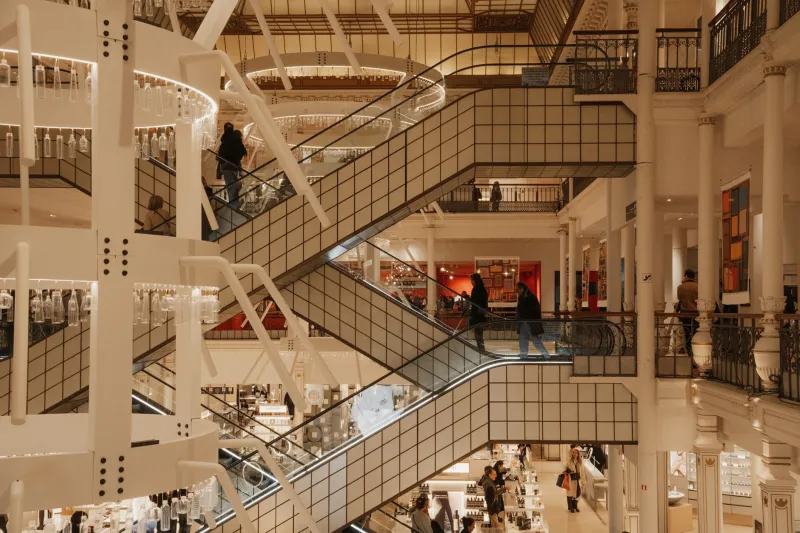
Floors were organized to create discovery. You went in for a winter coat and found yourself, forty-five minutes later, examining a set of serving dishes on a floor you hadn't planned to visit. The escalators were positioned so that reaching any destination required passing through departments you hadn't come for. Display cases were lit like jewelry boxes. The cosmetics counters on the ground floor hit you with fragrance the moment you walked in — a deliberate sensory welcome that said this is a special place.
There was a restaurant, usually. A tearoom, a lunch counter, or at minimum a café where you could sit down mid-trip, rest your feet, and review what you'd found. The store wasn't asking you to be efficient. It was asking you to linger.
And people did. Whole Saturdays were organized around it.
The Social Architecture of Browsing
What made the department store experience distinct from any form of shopping that has followed it was the element of genuine surprise. You didn't arrive knowing what you would find. The inventory was curated by buyers whose job was to anticipate what you might want before you knew you wanted it. Discovery was built into the model.
This is categorically different from what happens when you open a shopping app today. The algorithm knows your purchase history. It knows your browsing patterns, your price range, and — with unnerving precision — your approximate age and lifestyle. It shows you things it is confident you will buy. The element of surprise has been engineered out of the experience in the name of relevance.
What's lost in that trade is harder to name but easy to feel. The unexpected item — the scarf in a color you'd never have searched for but immediately loved, the book you stumbled across in the housewares section for reasons nobody could explain — doesn't exist in an algorithmic feed. You can only discover what the system decides to show you.
The Sales Associate Who Knew Your Size
There's another piece of the old department store experience that has largely disappeared: the knowledgeable sales associate who treated their department like a professional domain.
In the mid-twentieth century, working the women's clothing floor at a well-regarded department store was a real career. Associates knew their inventory in detail. They remembered customers. They knew who preferred a certain cut, who was shopping for a specific occasion, who needed to be steered gently away from the color that wasn't working. This wasn't just customer service — it was a kind of retail expertise that took years to develop.
That role has been hollowed out in most retail environments over the past three decades, first by cost-cutting and then by the rise of e-commerce, which removed the interaction entirely. Today's online shopping experience offers a chatbot and a size guide. The person who knew you — and knew the stock — is largely gone.
What the Economics Did to the Experience
The decline of the department store wasn't simply a matter of consumer preference. The economics shifted underneath the entire model.
Malls overbuilt aggressively through the 1980s and 1990s, diluting foot traffic across too many locations. Discount retailers like Walmart and Target captured the middle market. Then e-commerce arrived and captured the convenience market. The department store — which had always sold a combination of merchandise and experience — found itself competing on merchandise alone, and losing.
Between 2010 and 2020, the United States lost hundreds of department store locations. Anchor stores that had held malls together for decades closed, and the malls often followed. The retail landscape that replaced them is more efficient, more price-competitive, and considerably less interesting to spend a Saturday in.
The Thing About Browsing in Person
There's a body of consumer research suggesting that physical browsing — the kind you do when you're wandering a store without a specific goal — produces a fundamentally different relationship to what you buy. Items discovered by chance tend to be valued more highly. The act of physically handling something before purchasing it creates a sense of ownership and attachment that a product photo doesn't replicate.
There's also the social dimension. Shopping with a friend or a family member used to be genuinely collaborative. You held things up, got opinions, wandered in different directions and reconvened at the escalator. It was an activity you did together, in a shared physical space, with shared observations about what you saw.
None of that has a clean equivalent online. You can share a product link. You can video call while scrolling. But the experience of being in a place together, discovering things in real time, is something the digital version has never quite figured out how to replicate.
Getting Dressed to Go Nowhere in Particular
The Saturday shopping trip still exists, in a reduced form. Specialty stores, boutiques, and the handful of surviving department stores still draw customers who want the physical experience. Farmers markets and vintage shops have absorbed some of the browsing impulse. People still go out looking for things.
But the center of gravity has shifted decisively. The default is now the screen, the app, the two-day delivery. Getting dressed and going downtown to see what's there is no longer the obvious first move — it's almost a deliberate choice, a small act of resistance against the frictionless alternative.
For the generations who grew up with the department store as a genuine destination, that shift is noticeable in a way that's hard to fully articulate. It's not just that shopping changed. It's that an entire category of shared public experience — one organized around leisure, discovery, and the pleasure of being somewhere worth going — quietly closed its revolving doors.
The algorithm is very good at showing you what you already want. It never learned how to show you something you didn't know you were looking for.