The Face You Could No Longer Picture: Memory, Loss, and the Photograph That Changed Everything
There's a particular kind of grief that almost nobody experiences anymore. It was common once — so common that people rarely spoke of it, the way you don't remark on something that simply is. It was the grief of forgetting a face.
Not forgetting a person. Not losing the memories of what they meant or what they said or how they made you feel. Just losing the specific, visual fact of them — the exact color of their eyes, the way their mouth looked when they smiled, the particular angle of their nose. Without a photograph, those details faded. And for most of human history, most people left almost no photographs behind.
When a Portrait Was a Once-in-a-Lifetime Event
The photograph is a relatively young invention — daguerreotypes emerged in 1839 — but for most of its first century, it remained something formal, expensive, and rare. Well into the mid-twentieth century, the average American family didn't own a camera. If they had images at all, they were deliberate ones: a wedding portrait, a school photo, a snapshot taken by a relative who owned the equipment.
Think about what that meant practically. You might have five photographs of your mother. Maybe ten, if your family was prosperous and photo-minded. Those images were treated accordingly — stored carefully, framed prominently, handled with the knowledge that they were irreplaceable. A house fire that destroyed family photographs was understood to be a genuine tragedy, not just a property loss.
When someone died, those few images became intensely precious. They were what stood between memory and forgetting. Elderly relatives would gather around them and say things like, "That's exactly how he looked" — because the alternative was that no one could quite remember anymore.
The grief of a fading face was real and acknowledged. People wrote about it in letters. They described lying awake trying to reconstruct a lost loved one's features and finding the image slipping. It was one of the specific textures of bereavement that everyone understood.
The Kodak Moment and What Came After
The democratization of photography began in earnest with Kodak's Brownie camera at the turn of the twentieth century and accelerated through the mid-century as cameras became cheaper and film processing more accessible. By the 1960s and 70s, many American families owned a camera and used it for birthdays, holidays, and vacations.
But even then, photography had friction. You had a finite number of exposures on a roll of film — typically 24 or 36. You chose your moments carefully, or at least somewhat carefully. You couldn't see the result until the film was developed, which meant a trip to the drugstore and a wait of several days. Bad exposures and blinking subjects were discovered after the fact, when there was no chance to reshoot.
That friction shaped behavior. You pointed the camera at things that felt worth the cost and effort. You weren't documenting Tuesday afternoon. You were marking occasions.
The digital camera changed the cost equation. Suddenly, the marginal cost of an additional photo was zero. And then the smartphone collapsed the distance between the camera and your pocket entirely, making photography not an activity you did but a reflex available at every moment.
Infinite Images, Shifting Memory
Today, the average American takes thousands of photographs a year. Apple has reported that over a trillion photos are taken globally each year. The problem of forgetting a face has been essentially solved — every person in your life is documented from dozens of angles, in hundreds of moments, searchable by date and location on a device you carry everywhere.
This is genuinely remarkable. The specific grief of a fading face is now largely foreign to anyone under forty. Children growing up today will have photographic records of their lives so comprehensive that future generations will know not just what they looked like at six, but what they ate for breakfast on a random Wednesday.
But researchers who study memory and cognition have started asking a different question: what happens to memory when documentation becomes total?
The answer is more complicated than it might seem. Memory, it turns out, is not a recording device. It's a reconstructive process — every time you remember something, you're partially rebuilding it, which is why memories shift over time and why eyewitness testimony is notoriously unreliable. The act of remembering is itself a kind of mental exercise that reinforces and shapes what you retain.
When you photograph a moment instead of fully inhabiting it, some research suggests you're outsourcing the memory to the device rather than encoding it yourself. Studies have found that people who photograph objects in museums remember fewer details about them than people who simply look. The photograph becomes a substitute for memory rather than a supplement to it.
The Archive Nobody Looks At
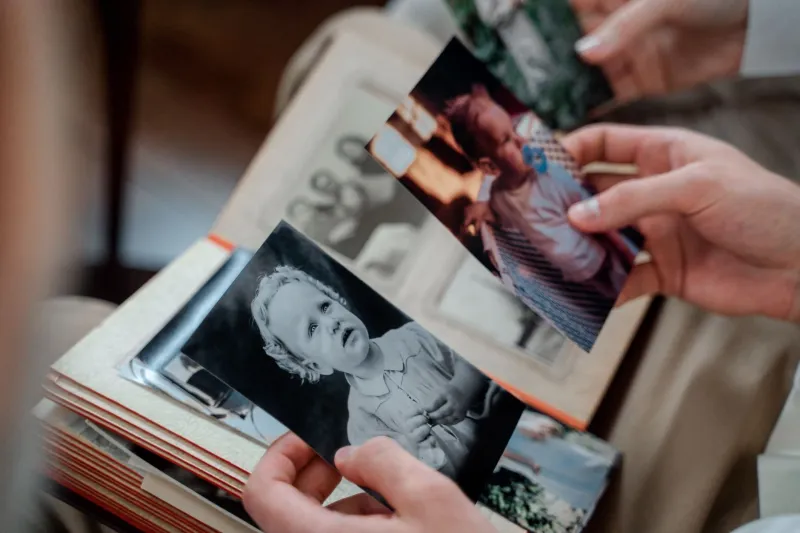
There's another irony embedded in all this. The photographs that were precious in 1955 were looked at regularly. They sat in frames on mantels or in albums that came out on Sunday afternoons. The act of revisiting them was itself a form of memory maintenance — a regular, communal ritual of remembrance.
The photographs on your phone? Most of them are never seen again. The average smartphone contains thousands of images that their owner hasn't looked at since the day they were taken. The documentation is total; the engagement is minimal. We have preserved everything and curated almost nothing.
There's something quietly strange about that trade. The family in 1955 with their twelve photographs looked at those twelve photographs constantly, talked about them, knew every detail in every frame. The family today with forty thousand images on a shared cloud account can't find the one they're looking for and mostly scroll past the rest.
What Memory Actually Needs
None of this is an argument against photography. The ability to preserve a face, a moment, a person as they actually were — that's a profound human gift that shouldn't be minimized.
But it's worth understanding that memory is not just storage. It's relationship. The photographs that mattered most in earlier generations mattered because they were chosen, displayed, revisited, and shared as part of ongoing life. They were woven into the present tense, not archived in a folder.
The challenge of the digital age isn't preservation — we've solved that completely. The challenge is meaning. With infinite images, the work of deciding what matters, what gets printed and framed and looked at on a Sunday afternoon, falls entirely to us. Nobody is making us do it. And mostly, we don't.
Somewhere in that gap between the precious and the infinite, something about how we remember — and who we remember — has quietly shifted.