The Homes That Knew How to Stay Cool — Before We Stopped Asking Them To
The Homes That Knew How to Stay Cool — Before We Stopped Asking Them To
If you've ever walked into an old Southern plantation house in July and noticed that it was somehow bearable — even pleasant — without any mechanical cooling running, you've experienced something that took centuries to develop and about thirty years to completely abandon.
Pre-air conditioning American architecture wasn't just old-fashioned. In many ways, it was brilliant. Builders across different regions developed sophisticated, climate-specific strategies for managing heat that were baked into every design decision, from the angle of the roof to the placement of every window. They didn't have a choice. Comfort was something you engineered into the building, because there was no machine to compensate for a bad design later.
Then, in the second half of the 20th century, central air conditioning arrived and changed everything — including, quietly and completely, the way Americans thought about the buildings they lived in.
Building With the Climate
The passive cooling strategies used in pre-air conditioning American homes varied by region, but the underlying logic was consistent: understand where the heat comes from, where the breeze goes, and design accordingly.
In the Deep South, the shotgun house and the dogtrot were both architectural responses to brutal summer heat. The dogtrot — two cabins connected by a covered open breezeway — was essentially a machine for capturing cross-ventilation. Wind moved through the central passage constantly, cooling both living spaces and creating a shaded outdoor area that functioned as a third room for much of the year.
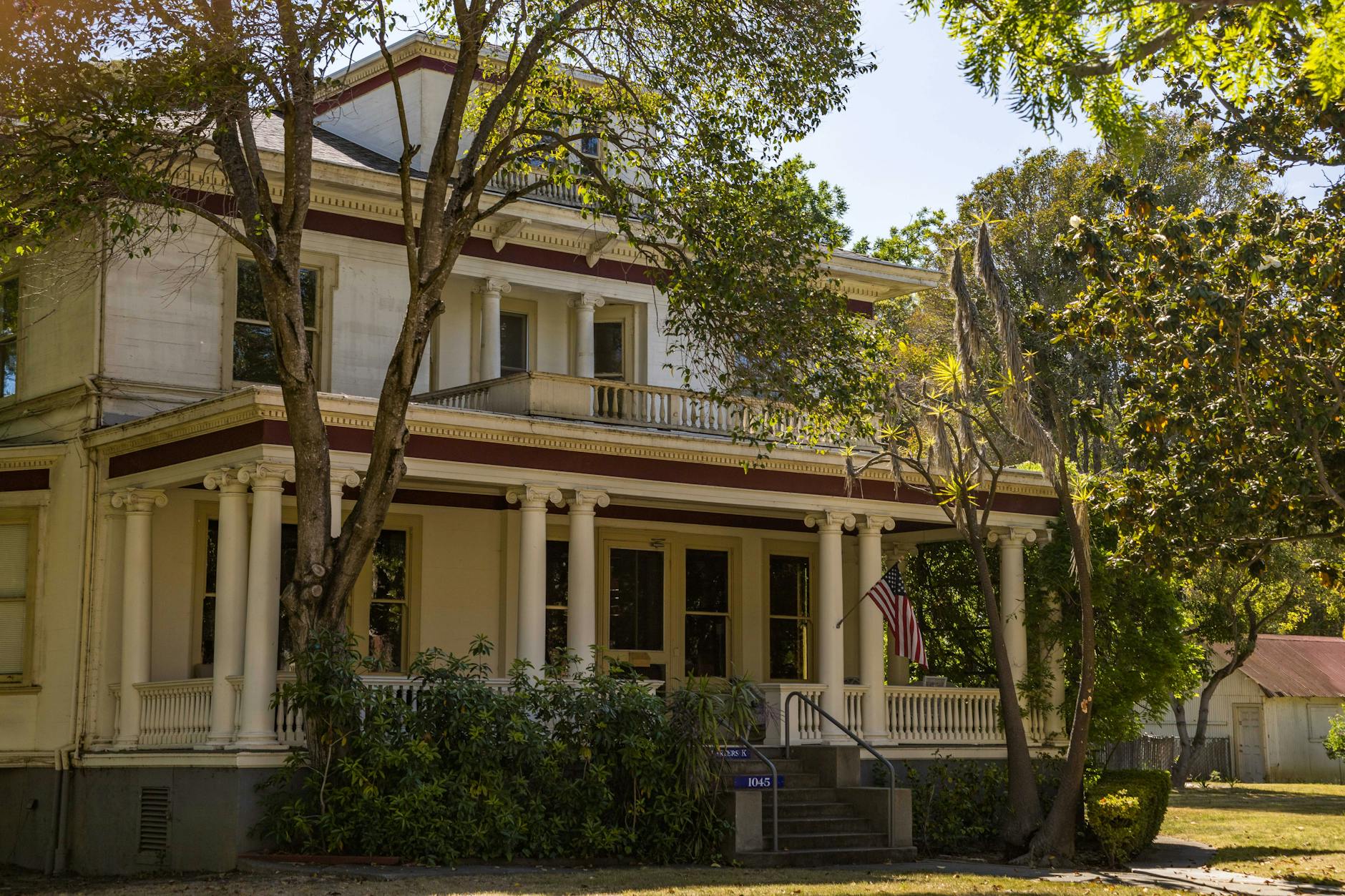
The sleeping porch was another widespread solution, common from the South through the Midwest and into the Northeast. These screened or open-air extensions of the second floor allowed families to sleep outside on the hottest nights without exposure to insects. In many homes built between roughly 1890 and 1940, the sleeping porch was a standard feature, as expected as a kitchen or a bathroom.
High ceilings — twelve, fourteen, even sixteen feet in grander homes — allowed hot air to rise away from occupants and stratify near the ceiling, where transom windows above doorways could vent it out. These weren't decorative choices. They were thermal management strategies.
Thick masonry walls, common in Southwestern adobe construction and in the brick rowhouses of Northern cities, functioned as thermal mass — absorbing heat during the day and releasing it slowly overnight, smoothing out the temperature swings that made thin-walled buildings unbearable. Spanish Colonial architecture in California and the Southwest took this further, with deep covered porticos that shaded walls and windows from direct sun while still allowing air movement.
Trees were infrastructure. Strategic planting of deciduous trees on the south and west sides of a house was standard practice — providing shade in summer while allowing winter sun through after the leaves dropped. Some builders oriented entire neighborhoods to maximize natural airflow, aligning streets with prevailing winds so that every house on the block could benefit.
The Invention That Made All of This Irrelevant
Willis Carrier developed the first modern air conditioning system in 1902, but it took decades for the technology to reach residential homes at scale. Window units became widely available in the late 1940s and 1950s. Central air conditioning systems followed through the 1960s and 1970s, and by the 1980s, they were standard in new construction across most of the country.
The effect on architectural thinking was swift and, in retrospect, almost total.
If a mechanical system could guarantee comfortable indoor temperatures regardless of design, then the design didn't need to do that work anymore. Ceilings dropped to the modern standard of eight feet — cheaper to build, easier to heat and cool with forced air. Sleeping porches disappeared. Transom windows vanished. Thick masonry gave way to wood-frame construction with thin insulation batts. Trees became landscaping choices rather than climate tools.
Homes became sealed boxes — tightly constructed envelopes designed to hold conditioned air in and outdoor air out. The relationship between the building and its climate, which had been the central organizing principle of residential design for centuries, was simply... severed.
This wasn't malicious or careless. It was rational, given the assumptions of the time. Energy was cheap, air conditioning was reliable, and there was no obvious reason to complicate the construction process with passive design features that the HVAC system would handle anyway.
The Bill Comes Due
Those assumptions look considerably shakier today.
Residential air conditioning accounts for roughly 6 percent of all electricity produced in the United States annually — generating around 117 million metric tons of carbon dioxide emissions each year, according to the U.S. Department of Energy. As summers grow longer and hotter across much of the country, that number is rising. Peak electricity demand during heat waves is already straining grids in Texas, California, and the Southwest. The sealed, mechanically-cooled home that seemed like pure progress in 1975 is now a significant contributor to the conditions making those homes necessary in the first place.
There's also the straightforward matter of cost. Running central air conditioning through a long Southern summer can add hundreds of dollars to monthly utility bills. In a poorly designed modern home — oriented wrong, with large west-facing windows and minimal shade — the mechanical system is working constantly against physics that a smarter design could have harnessed for free.
The Old Playbook, Revisited
Here's the part that feels almost ironic: the architectural community is currently experiencing a significant revival of interest in passive cooling design, and the solutions being promoted look remarkably familiar.
The principles of passive house design — thick, well-insulated walls, careful window orientation, natural ventilation strategies, thermal mass — are essentially a modernized version of what American builders knew instinctively before air conditioning arrived. Organizations like the Passive House Institute US are advocating for buildings that minimize mechanical cooling needs through smart design. Green building standards increasingly reward features like exterior shading, cross-ventilation, and reflective roofing materials.
Some architects are explicitly studying vernacular regional architecture — the very dogtrot houses and adobe walls and sleeping porches that the 20th century abandoned — and translating those principles into contemporary design language.
Meanwhile, homeowners in older neighborhoods are rediscovering the practical value of mature tree canopies, covered porches, and operable windows that their grandparents' generation took entirely for granted.
The knowledge was never actually lost. It was just sitting in old buildings, waiting to be remembered.
There's something quietly humbling about that. A generation of builders who worked without computers, without climate models, and without any of the sophisticated energy analysis tools available today managed to design homes that worked with their environment in ways that modern construction is only now beginning to catch up to.
They didn't have air conditioning. So they built houses that didn't need it. And for a long time, that was enough.