Your Great-Grandmother's Backyard Fed Her Family. Yours Grows Nothing but Lawn Bills.
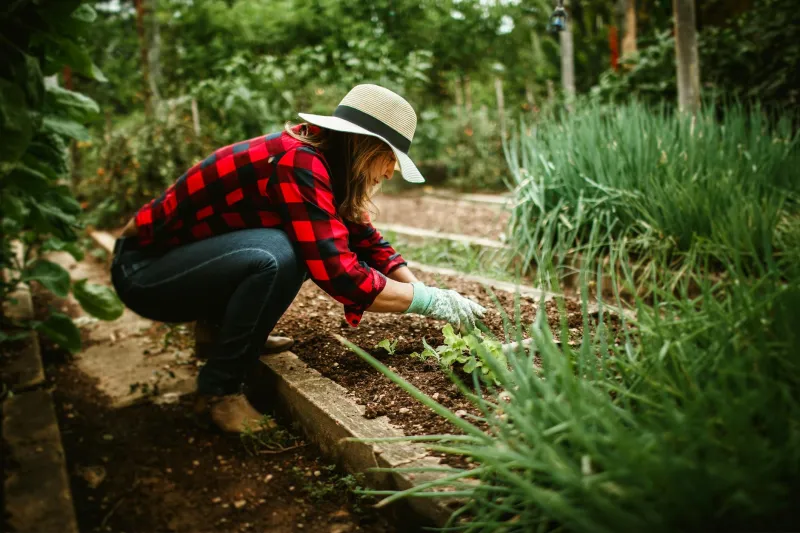
Your Great-Grandmother's Backyard Fed Her Family. Yours Grows Nothing but Lawn Bills.
The average American household spends somewhere between $1,200 and $1,500 a year maintaining their lawn. Fertilizer, mowing, edging, weed control, sprinkler systems — all to keep a rectangle of grass looking presentable. The yard produces nothing. It feeds no one. And the whole arrangement is treated as completely normal, even inevitable, as though it's always been this way.
It hasn't. Not even close.
What the Backyard Used to Be
For the majority of American history, outdoor space attached to a home was productive space. Not decorative — productive. Rural families, obviously, maintained full kitchen gardens and small livestock as a matter of survival. But this wasn't limited to farms. Urban and suburban households through the early twentieth century commonly kept vegetable patches, fruit trees, berry bushes, and in many cases chicken coops within city limits.
The kitchen garden — growing just behind or beside the house — was a standard feature of working-class and middle-class homes alike. Tomatoes, beans, squash, potatoes, onions, herbs: these were grown at home because buying everything at a store was expensive and, in many places, simply not how things were done. Canning and preserving extended the garden's output through winter months. Nothing was wasted.
During both World Wars, the federal government actively encouraged this tradition. Victory Gardens — the name given to home and community food plots during the war years — were planted in backyards, vacant lots, rooftops, and public parks across the country. By 1944, an estimated 20 million Victory Gardens were producing roughly 40 percent of the nation's vegetables. Forty percent. From backyard plots.
This wasn't fringe behavior. It was the mainstream.
The Lawn as Status Symbol
The shift happened fast, and it was largely engineered. The postwar suburban boom — Levittown, the GI Bill, the mass production of affordable single-family homes — created millions of new residential lots. And the developers, influenced by the aesthetic of English manor houses filtered through American aspiration, planted grass.
The lawn became a symbol of arrival. A well-maintained front yard signaled that you had time and money to spend on something purely aesthetic. It communicated that you weren't scratching for subsistence anymore — you were prosperous enough to grow nothing on purpose.
The lawn care industry, which barely existed before World War II, grew explosively alongside the suburbs. Chemical companies developed herbicides and synthetic fertilizers. Sprinkler systems became standard. The mower industry boomed. By the 1960s, the idea that a proper home had a proper lawn — green, uniform, free of vegetables — was deeply embedded in American suburban culture. Homeowners' associations would later formalize this aesthetic as policy, actually prohibiting food gardens in many communities.
The productive backyard didn't just fade out. In many places, it was actively discouraged.
What Was Lost
The numbers are striking when you lay them out. A 10-by-20-foot vegetable garden — a modest plot by any historical standard — can produce several hundred pounds of food per year under reasonably attentive care. Tomatoes, zucchini, leafy greens, peppers, and beans are among the highest-yielding crops for small spaces. A family growing even a fraction of their vegetable consumption saves meaningfully on grocery bills while eating produce that is, by any nutritional measure, fresher and more nutrient-dense than what traveled hundreds of miles to a supermarket shelf.
Beyond nutrition, there's the knowledge question. For most of human history, understanding how food grew was basic literacy. Children who grew up helping in the kitchen garden absorbed that knowledge by proximity — when to plant, how to thin seedlings, what pests to watch for, how to read soil and weather. That knowledge has now largely skipped two or three generations. Most American adults under 50 have no practical experience growing food and would struggle to start without significant guidance.
The food security dimension is real, too. The COVID-19 pandemic offered a brief, vivid reminder of what happens when supply chains stall. Grocery stores emptied. Seed companies reported a surge in orders unlike anything they'd seen in decades — and then discovered that a huge portion of their new customers had no idea where to begin.
The Quiet Return of the Kitchen Garden
Something is shifting, though. Slowly, and without much fanfare, Americans are returning to growing food at home. The National Gardening Association reported that food gardening participation in the U.S. increased by roughly 30 percent between 2008 and 2020, with the sharpest growth among younger households and urban dwellers.
Raised bed kits now sell at Home Depot and Costco. YouTube channels dedicated to small-space vegetable growing have accumulated millions of subscribers. In cities from Detroit to Los Angeles, community garden waiting lists are years long. A growing number of municipalities have quietly rolled back the HOA restrictions that once banned food plants in front yards.
The people leading this movement often describe the same experience: they started a small plot, grew a few tomatoes, and were caught off guard by how satisfying it was. Not just the food — the process. The connection to something seasonal and real.
A Different Kind of Progress
There's something worth sitting with here. We built the ornamental lawn as a symbol of prosperity — proof that we'd moved beyond the necessity of growing our own food. And now, a generation later, the people rediscovering the kitchen garden are often doing so precisely because they can afford not to, and they're choosing it anyway.
Maybe the productive backyard was never really something we outgrew. Maybe we just forgot, for a few decades, that it was worth keeping.