When Feeding a Family Meant Leaving the House Every Single Morning
Somewhere in the back of your refrigerator right now, there is probably something you bought last weekend that you're no longer going to eat. A bunch of cilantro going soft at the edges. Half a rotisserie chicken in a zip-lock bag. Some yogurt that expires tomorrow. This is the quiet tax of the modern grocery system — we buy in bulk, we store it cold, and we accept a certain amount of waste as the natural cost of convenience.
A hundred years ago, none of that math existed. There was no bulk. There was barely any storage. And convenience, as we understand it today, was not yet a concept anyone was chasing.
The Daily Errand That Built the Neighborhood
For much of American history — well into the early twentieth century in most cities, and longer in rural areas — feeding a family meant going out to get food every day. Not every few days. Every day.
The icebox, the predecessor to the modern refrigerator, could keep things cold for a short window if the iceman came regularly and you managed it carefully. But it wasn't reliable enough to store a week's worth of perishables, and most working-class families didn't have large ones anyway. So the solution was simple: you bought what you needed for that day, or perhaps tomorrow, and you went back the next morning.
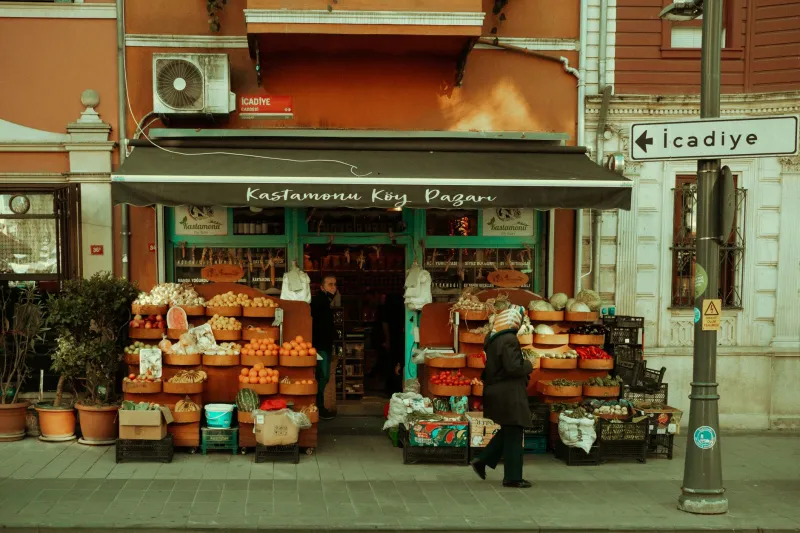
This meant a different kind of relationship with food and with the people who sold it. You didn't go to one store. You went to several. The bakery for bread. The butcher for meat. The dairyman — or his delivery cart — for milk and butter. The produce vendor, often operating from a cart or a small market stall, for whatever was in season. Each stop was its own transaction, its own brief conversation, its own social moment embedded in the routine of feeding your household.
The streets of American cities in the late 1800s and early 1900s were full of this kind of commerce. Pushcart vendors were a fixture in immigrant neighborhoods in cities like New York, Chicago, and Philadelphia. The street itself was a market, loud and specific and intensely local.
What the Supermarket Changed
The modern supermarket didn't arrive fully formed. It evolved through a series of steps. The first self-service grocery store — where customers picked items off shelves themselves rather than asking a clerk to retrieve them — opened in Memphis, Tennessee, in 1916. Piggly Wiggly, the chain behind it, was a genuine revolution in how Americans bought food.
But the true transformation came later, accelerated by two things: the mass adoption of home refrigerators in the 1930s and 1940s, and the post-war suburban expansion that made large-format stores practical. Once families had reliable cold storage at home, buying in larger quantities made sense. Once suburbs spread out and car ownership became near-universal, a store that required driving to could still be the most convenient option.
By the 1950s, the supermarket as we know it was taking its modern shape — vast, fluorescent-lit, stocked with everything from canned goods to frozen dinners, and designed for the once-a-week shopping trip that has defined American grocery culture ever since.
Convenience was the pitch, and it delivered. One trip. One store. A week's worth of food loaded into the trunk of the station wagon and done.
What Quietly Disappeared
What the supermarket gave in efficiency, it quietly took in other ways — and not all of those trade-offs are obvious until you look at them directly.
The daily shopping rhythm was social infrastructure. The butcher who knew how many people were at your table. The baker who set aside a loaf because he knew you came in every Tuesday. These weren't just transactions — they were a form of community maintenance, small repeated interactions that built familiarity and trust over time. When the weekly mega-haul replaced the daily round, that web of micro-connections largely disappeared.
Diet shifted too. Daily shopping meant daily freshness — you bought what was available, what was in season, what had just come in. The modern supermarket, with its global supply chains and year-round produce sections, offers theoretical variety but often at the cost of flavor and nutritional density. A tomato available in January in Minnesota is a logistical achievement. Whether it tastes like a tomato is another question.
Food waste, already mentioned, is the other side of this coin. The USDA estimates that American households waste somewhere between 30 and 40 percent of the food supply. Some of that is systemic, happening before food ever reaches the store. But a significant portion happens at home, in refrigerators stocked with ambitious weekly plans that reality never quite matches.
The Pendulum Swings
Something interesting has been happening in recent years. Farmers markets have made a significant comeback across the United States, particularly in urban areas. Community-supported agriculture — where families buy a weekly share of a local farm's output — has built a dedicated following. Specialty grocery stores emphasizing local and seasonal products have found a loyal customer base willing to pay more for something that feels closer to the old model.
Online grocery delivery has pulled in the opposite direction, making the weekly haul even more passive — items arrive at the door without the shopper ever setting foot in a store. Both trends are responses to the same underlying feeling: that something about the current system isn't quite satisfying, even if no one can agree on what to replace it with.
A Different Kind of Errand
The daily shopping trip of a century ago was inefficient by modern standards. It was time-consuming, physically demanding, and dependent on weather, vendor availability, and whatever happened to be fresh that morning. Nobody is seriously proposing we go back to it.
But there's something worth sitting with in the contrast. The errand that once connected people to their neighbors, to the seasons, and to where their food actually came from has become one of the most solitary acts in the American week — headphones in, list on the phone, cart through the fluorescent aisles, back to the car.
We gained an enormous amount of convenience. The question of what else was in that trade is one the modern supermarket doesn't exactly advertise on the label.