The Tooth Puller Came to Town and Nobody Was Happy to See Him
Imagine your tooth has been aching for two weeks. The pain radiates up your jaw, keeps you awake at night, and makes eating anything harder than soup an exercise in misery. Now imagine your only option is a man who rolls into your county once a month, sets up in the town square, and yanks the offending tooth out with a pair of iron forceps — no anesthetic, no sterile equipment, and a crowd of onlookers who are either sympathetic or morbidly curious.
That was dental care for much of early American history. And for millions of people, it wasn't even that organized.
When the Kitchen Table Was the Operating Chair
In colonial America and well into the 1800s, there was no such thing as a licensed dentist in most communities. Teeth were handled by whoever was available — a barber, a blacksmith, a traveling "tooth-drawer" who might also sell patent medicines and cure your horse's lameness if you asked nicely. In rural areas, a bad tooth often meant a family member did the job themselves, using pliers or whatever tool came closest to the task.
The pain of extraction was simply accepted as part of life. There was no way around it. Clove oil and whiskey were the most common remedies for dulling the agony beforehand, and neither worked particularly well. Infections that followed an extraction — or that went untreated because no one came to pull the tooth at all — could turn fatal. A bad molar wasn't just an inconvenience. It was a genuine threat.
Homemade toothache remedies filled household recipe books alongside pie crusts and cold remedies. Turpentine. Coal tar. Tobacco ash packed into the cavity. Some people swore by these things. Most people were just desperate.
The Profession That Grew Up Slowly
Formal dental education in America began to take shape in the mid-1800s. The Baltimore College of Dental Surgery, founded in 1840, is widely considered the first dental school in the world. But even as the profession organized itself, access remained deeply uneven. Urban Americans with money could see a trained dentist. Rural and working-class families largely could not.
Nitrous oxide — laughing gas — began appearing in dental offices in the 1840s, and novocaine arrived in the early 1900s. These were genuine turning points. The idea that a tooth could be treated without the patient gripping the chair arms and bracing for the worst was almost radical. Pain had been so central to the dental experience that removing it changed the entire relationship between patient and practitioner.
But even as techniques improved, fear didn't disappear overnight. Generations of Americans grew up hearing stories about what the dentist used to be like, and those stories had a way of sticking around long after the tools changed.
What the Modern Chair Actually Represents
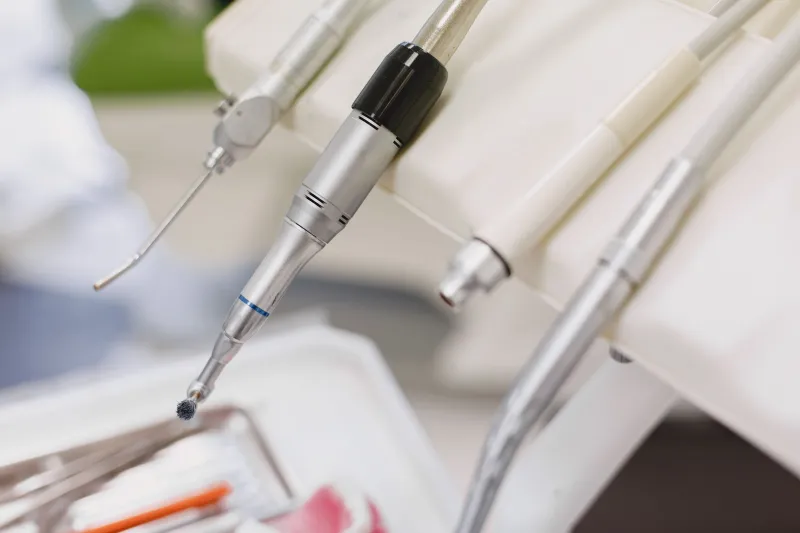
Walk into a dental office today and the contrast with the town-square tooth-drawer is almost impossible to fully absorb. Digital X-rays produce detailed images of your entire jaw structure in seconds, revealing decay, bone loss, and structural problems that would have been invisible to any practitioner a century ago. Local anesthetics are so effective that most patients feel pressure but no pain during procedures that would have been considered surgical nightmares in earlier eras.
CAD/CAM technology — computer-aided design and manufacturing — now allows some dental offices to mill a permanent crown on-site in a single visit. A process that once required temporary fittings, weeks of waiting, and multiple appointments now happens while you sit in the chair for a couple of hours. Same-day crowns aren't available everywhere, but the fact that they exist at all would have seemed like science fiction to a patient in 1920.
Teeth whitening, invisible aligners, dental implants that fuse to the jawbone — these aren't just cosmetic upgrades. They represent a fundamental shift in what we believe teeth are for and how long we expect them to last. The idea that losing teeth was simply part of aging, accepted and inevitable, has been replaced by an expectation that with proper care, your original teeth can last a lifetime.
The Fear That Outlasted the Pain
Here's the curious part of this story. Dental anxiety remains remarkably common in the United States. Studies suggest that somewhere between 9 and 20 percent of Americans avoid the dentist because of fear — fear that, for most people today, is no longer proportionate to the actual experience waiting for them.
Some of that anxiety is inherited. It was passed down through families who really did have reason to be afraid, whose experiences with dental care involved genuine suffering. The emotional memory of what the dentist used to mean outlasted the reality of what it became. That's a strange kind of cultural lag — carrying dread for a version of something that no longer quite exists.
Sedation dentistry has emerged partly in response to this, offering anxious patients the option to be lightly sedated for procedures that are, by any objective measure, far less traumatic than what previous generations endured without any sedation at all.
What Changed, and What It Tells Us
The arc of American dental care is really a story about what we decide people deserve. For a long time, the answer was: endure it. Pain was the price of having teeth, and if you couldn't afford a trained practitioner or didn't have access to one, you improvised and suffered.
What changed wasn't just technology, though technology changed enormously. What changed was the baseline expectation. Comfort became the standard, not the luxury. A routine cleaning is now genuinely routine — a Tuesday appointment, a little scraping, maybe a fluoride treatment, and you're back in your car before the afternoon is over.
The traveling tooth-drawer in the town square would find today's dental office unrecognizable. The patients in those offices, sitting back in padded chairs under warm lights while a hygienist asks about their weekend, probably don't spend much time thinking about how different things used to be.
Maybe they should. The absence of agony is its own kind of progress — and it took longer to arrive than most of us realize.