One Phone, Mounted to the Wall, and the Whole House Already Knew Your Business
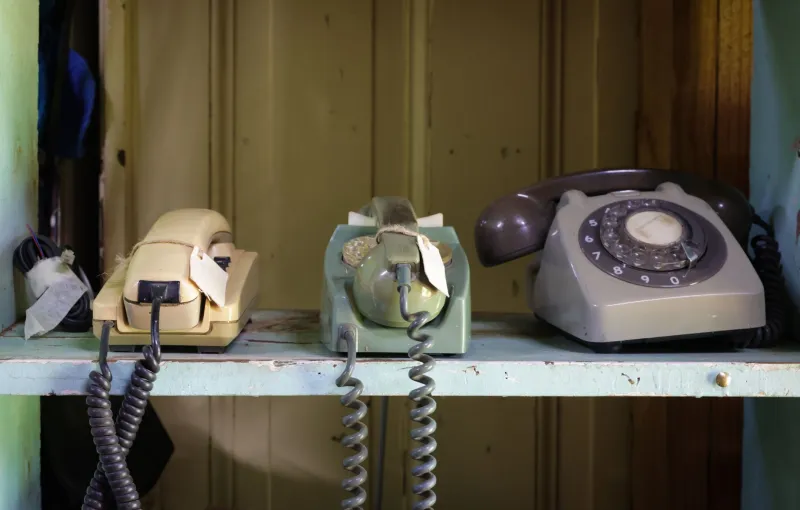
If you grew up in America before roughly 1995, you know the particular anxiety of trying to have a private conversation in a house with one telephone. You'd stretch the cord as far as it would go — around the corner, into the hallway, maybe a few feet into the bathroom if the cord was long enough — and you'd speak in a low, urgent voice while your mother made dinner eight feet away and pretended not to listen.
She was absolutely listening.
That single wall-mounted telephone, usually in the kitchen, was the nervous system of the American household for most of the twentieth century. And the way it worked — shared, public, entirely without privacy — shaped family life in ways that are almost unrecognizable today.
The Logistics of Shared Communication
Let's start with the basics, because younger readers may genuinely not understand the mechanics. One phone number. One physical device. Everyone in the house used it, and everyone in the house knew when it rang.
If you weren't home when someone called, they'd leave a message — not on voicemail, but with whoever picked up. Usually a sibling, occasionally a parent, sometimes a younger brother who would repeat your personal business at dinner with complete accuracy and zero mercy. Message-taking was a skill, and households had systems. A notepad by the phone. A specific pencil. A ritual that kept the household's social calendar running.
Long-distance calls were expensive enough that families had actual policies about them. Some households had a strict no-long-distance rule on weeknights. Others kept calls to three minutes. The cost of calling your college roommate from the family kitchen in 1978 was a real financial consideration, not a hypothetical one.
What It Did to Family Dynamics
The shared phone created a kind of enforced transparency within the household that no amount of teenage ingenuity could fully defeat. Parents knew who called. They knew how often. They knew the voice on the other end, because they'd picked up the phone themselves. There was a social accountability built into the infrastructure.
This wasn't always comfortable, and it wasn't always fair. Young women especially navigated a world where their romantic lives were visible to their entire family by default, simply because the phone was in the kitchen. A boy calling the house meant speaking to whoever answered — often a father — before getting to the person he actually wanted to reach. That small ritual carried a social weight that has completely evaporated.
At the same time, the shared phone meant that families genuinely knew each other's social worlds. Parents knew their kids' friends by voice. Siblings knew who was important in each other's lives. There was an accidental intimacy to it — not always welcome, but real.
The Cord That Changed Everything
The first significant privacy upgrade was the extension phone — a second handset in a bedroom that allowed for slightly more discreet conversation, provided nobody picked up the kitchen phone mid-call and breathed audibly into the receiver. (They always did.) The cordless phone, which became widespread in the 1980s, offered mobility but not true privacy. You could wander into the backyard, but the signal was often terrible and the battery lasted forty minutes on a good day.
The real disruption came with the cell phone, and specifically with the moment cell phones became cheap enough and common enough that teenagers had their own. That shift — individual phone numbers for individual people — fundamentally rewired the household's communication architecture.
Suddenly, a call to a teenager bypassed the family entirely. No message-taking. No parental interception. No accidental eavesdropping. The invisible bubble formed — a personal communication channel that existed within the home but was completely separate from it.
The Invisible Walls Inside the House
Today, a family of four sitting in the same living room may be communicating with four entirely separate social networks, and nobody in that room has any idea what the others are saying. That's not a criticism — it's just the reality of what personal devices created.
But consider what shifted in terms of parental awareness. A parent in 1975 had a reasonably clear picture of who their teenager was talking to, simply because those conversations happened on a shared device in a shared space. A parent today may have almost no visibility into their child's communication life unless they actively seek it — and doing so now carries a very different social meaning than simply being in the kitchen when the phone rang.
Child psychologists have written extensively about this change, noting that the loss of ambient family awareness — the kind that happened naturally when communication was shared — has created new challenges around adolescent risk and isolation that didn't exist in the same form when the phone was on the wall.
What the Kitchen Phone Actually Was
Looking back, that wall-mounted telephone wasn't just a communication tool. It was a social structure. It enforced accountability. It created accidental connection. It made the household's relationships visible to everyone in it.
Was it inconvenient? Absolutely. Was it an invasion of privacy? Often. Would anyone who grew up with it trade their smartphone for it? Almost certainly not.
But it's worth pausing to notice what disappeared when the cord got cut for good — not just from the wall, but from the idea that communication within a family was something everyone shared, whether they wanted to or not.
Some of that shared life was annoying. Some of it, it turns out, was holding things together.