You Used to Sit With Strangers Before the Doctor Would See You — Now You Just Get a Text
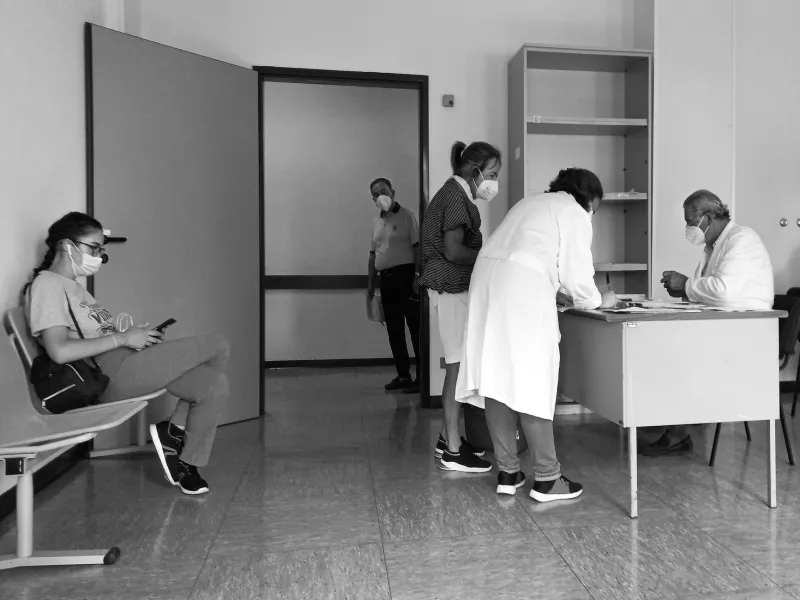
There was a particular rhythm to a doctor's visit that most Americans over thirty still remember in their bones. You'd walk through a heavy glass door, sign your name on a clipboard, take a number or just find a seat, and then — you waited. Not for five minutes. Not with your phone to keep you company. You waited in a room full of other people, all of you quietly pretending not to notice each other's coughs.
That waiting room was, in its own strange way, one of the last truly democratic spaces in American life.
The Room Where Everyone Was Equal
It didn't matter if you were a teacher, a plumber, or a retired accountant. In the waiting room, you were all just patients. You sat in the same molded plastic chairs. You reached for the same battered copy of People magazine from three months ago. You watched the same small television mounted too high on the wall, usually tuned to a local news channel nobody asked for.
And you talked. Not always, not deeply, but you did. The woman next to you might mention she'd been coming to this practice for twenty years. The older gentleman across the aisle might ask what you were in for, not out of nosiness, but because there was simply nothing else to do. Children fidgeted. Receptionists answered phones with practiced calm. The fish tank in the corner — there was almost always a fish tank — provided a kind of ambient white noise that said: slow down, you're not in charge of the schedule here.
For many people, especially older Americans living alone, that waiting room was a social event. A reason to get dressed. A place where somebody knew your name.
What Changed, and How Fast It Changed
The shift didn't happen overnight, but it accelerated sharply. Online appointment booking started chipping away at the clipboard ritual sometime in the 2010s. Patient portals replaced phone tag with secure messaging. Automated text reminders replaced the receptionist's Tuesday afternoon call. Each individual change seemed like pure convenience — and honestly, it was.
Then came 2020, and telehealth went from a niche option to the only option for millions of Americans virtually overnight. By mid-2020, the Centers for Disease Control reported that telehealth visits had increased by roughly 154 percent compared to the same period the year before. Practices that had resisted the shift for years were fully digital within weeks.
Suddenly, your doctor's appointment happened in your kitchen. Or your car. Or your bedroom, with your unmade bed carefully cropped out of frame.
The Efficiency We Gained
It's worth being honest about what improved. Telehealth has been genuinely transformative for Americans in rural areas who previously faced multi-hour drives for routine consultations. It has made follow-up appointments easier to keep, reduced the spread of illness in shared waiting areas, and given people with mobility challenges access to care that was previously logistically complicated.
Virtual check-ins mean you're not sitting for forty-five minutes next to someone with a respiratory infection. Digital intake forms mean your doctor has already reviewed your history before you've said hello. The friction — the parking, the travel time, the waiting — has largely been engineered away.
For a generation that measures everything in efficiency, this looks like progress. And in many measurable ways, it is.
The Thing Nobody Put on the Metrics
But something else happened too, and it's harder to quantify.
The waiting room was, for a lot of Americans, a place where they observed that other people also struggled. You'd see a mother managing two sick kids and feel less alone in your own parenting chaos. You'd notice an elderly man carefully filling out his forms and feel a quiet nudge of empathy. The shared physical space created an unspoken acknowledgment: bodies are complicated, and we're all navigating that together.
None of that transfers to a Zoom window. When your appointment is a fifteen-minute video call that you join from your couch, the entire experience is optimized for transaction. Get in, describe symptoms, get the prescription sent to your pharmacy, log off. It's efficient. It's also oddly isolating in a way that's difficult to articulate until you sit with it.
There's also the question of what gets missed. Experienced physicians have long noted that a significant amount of diagnostic information comes from simply observing a patient walk into the room — their gait, their color, how they hold themselves, whether they seem anxious. A camera mounted on a laptop captures a face. It doesn't capture a person.
The Waiting Room Isn't Entirely Gone
It's worth noting that for many types of care — surgeries, complex diagnostics, specialist visits — the waiting room still exists. And in those spaces, the old rhythms remain. People still reach for the magazines. The fish tank is still there, or at least the idea of it.
But for routine care, the appointment has migrated. It lives on your phone now, tucked between a calendar reminder and a grocery list. It's faster, cleaner, and considerably more convenient.
Whether it's better is a different question entirely — and one that probably depends on whether you ever found yourself genuinely glad to be sitting in that plastic chair, next to a stranger who happened to say exactly the right thing.
Some people did. More than you'd think.